Genesee County has been identified by the U.S. Environmental Protection Agency (EPA) and New York State Department of Health as an area with elevated radon potential. Predicted average indoor radon levels may be at or above 4 picocuries per liter (pCi/L), the recommended action level.
There is no known safe level of radon exposure. Testing is the only way to determine whether elevated radon levels are present in your home. The Genesee County Health Department offers services to help residents test their homes and take corrective action when necessary.
GO Health Minutes
Radon Test Kits
Genesee County residents may contact the Genesee County Health Department to request a short-term radon test kit at no charge. Short-term kits test a home for two to seven days. A limited number of kits are available.
Residents outside Genesee County may purchase a test kit from a local hardware store or request one from the New York State Department of Health while supplies last. Visit the New York State Department of Health Radon Program for more information.
Community Education
The Health Department provides educational presentations and materials about radon, testing and mitigation options upon request at no charge.
Testing Your Home
Testing is the only way to determine whether your home has elevated radon levels. The New York State Department of Health, EPA and U.S. Surgeon General recommend testing all homes for radon. Testing is important whether you are purchasing a new house or checking your current home.
How to Complete a Short-Term Radon Test
How to Complete a Short-Term Radon Test (Video)
Radon is a naturally occurring radioactive gas produced by the breakdown of uranium in soil, rock and water beneath homes and other buildings. It is colorless and odorless.
Radon can enter a home through:
- Cracks in foundations and walls
- Construction joints
- Dirt floors
- Sump pump openings
- Gaps around suspended floors and pipes
- Well-water supplies
Any home can have elevated radon levels, whether it is old or new, has a basement or is built on a slab.
Long-term radon exposure can cause lung cancer in people who smoke and people who have never smoked. According to the EPA, radon is responsible for approximately 21,000 lung cancer deaths in the United States each year. About 2,900 of these deaths occur among people who have never smoked.
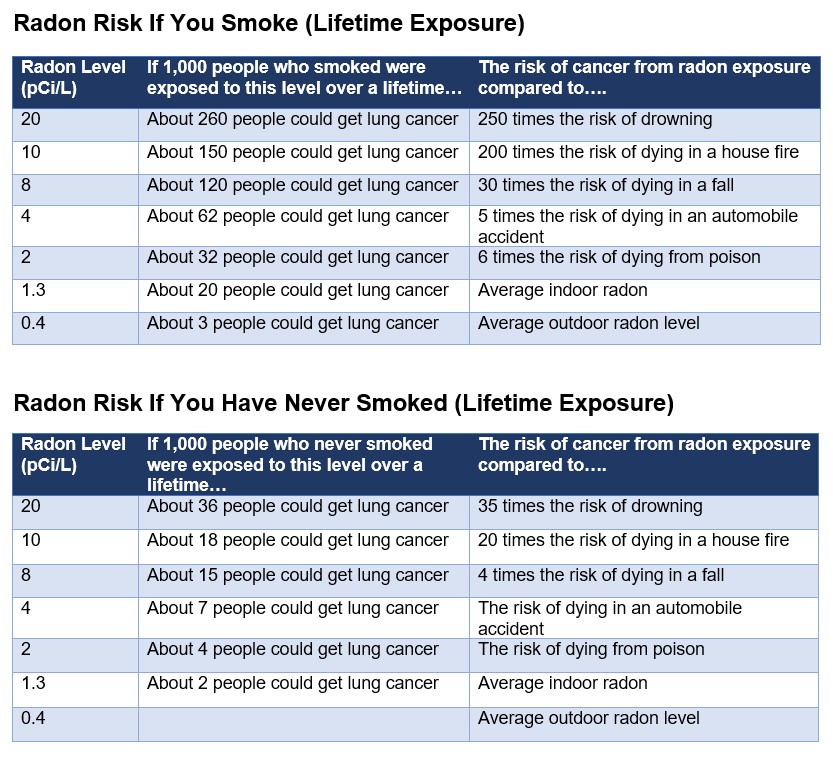
If testing confirms a radon level of 4 pCi/L or higher, New York State recommends taking steps to reduce the radon level. You may also want to consider mitigation when levels are between 2 and 4 pCi/L.
A radon reduction system can effectively reduce elevated radon levels. The system should be installed by a certified radon mitigation contractor. Reducing radon levels reduces the associated health risks.
Visit the New York State Department of Health list of certified radon mitigation contractors.