Invasive Species
Spongy Moth:
The spongy moth (Lymantria dispar) is a non-native insect from France. Its caterpillar (larva) stage eats the leaves of a large variety of trees such as oak, maple, apple, crabapple, aspen, willow, birch, mountain ash, pine, spruce, and more.
For more information, visit the NYS DEC website at: www.dec.ny.gov/animals/83118.html
Spotted Lanternfly:
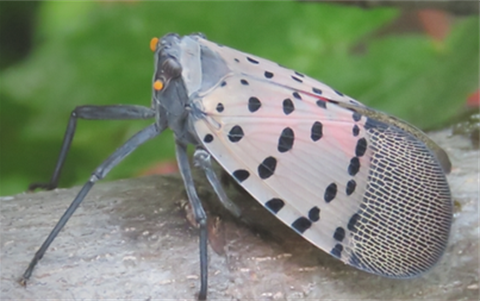
Lycorma delicatula, or Spotted Lanternfly (SLF), is an invasive plant hopper from Asia. In the United States, it was first found in Pennsylvania in 2014. Spotted Lanternfly has been found in New York State on Staten Island, Port Jervis, Sloatsburg, Orangeburg, and Ithaca. SLF threatens the agriculture and forestry industries, and is also a nuisance pest. The nymphs and adults feed on over 70 different plants with piercing sucking mouthparts. To read more about the Spotted Lanternfly, go to: agriculture.ny.gov/spottedlanternfly
Cornell's Integrated Pest Management website is another great resource: nysipm.cornell.edu/environment/invasive-species-exotic-pests/spotted-lanternfly
If you think you have seen a spotted lanternfly, please report ASAP by clicking here. You will need information about the location of the find, and ideally, photographs.
Emerald Ash Borer (EAB)
The Emerald Ash Borer (Agrilus planipennis) is a wood boring beetle from Asia that feeds on all native ash trees (Fraxinus sp.). First introduced to New York in 2009, the infestation quickly spread and has been the cause of death to millions of ash trees.
The EAB causes damage to ash trees throughout its entire life cycle. The eggs are laid inside the bark, where the larva then chew the living tissue creating “S” galleries, and then create D-shaped exit holes when emerging as adults. The adults are less than 1 inch long and have a metallic green wing cover with a coppery red abdomen. They are most often seen in June and July but can be seen in September.
Once infested, an ash tree will die within 2-4 years. They will show effects of decline by “blonding” of the trunk due to woodpeckers searching for larvae, yellowing or browning of the canopy, D-shaped exit holes, and the “S” shaped galleries on the bark.
Research into ash tree conservating is taking place, but no remediation is currently available. Homeowners can investigate treating their lingering ash trees – consult professionals prior to treatment or removal of the tree(s).
To prevent further spread of EAB, NYSDEC has regulated the movement of firewood. Do not move firewood of any species further than 50 miles of its origin. Learn more here: https://dec.ny.gov/nature/animals-fish-plants/emerald-ash-borer-eab
Emerald Ash Reference Image One(PNG, 52KB)
Emerald Ash Reference Image Two(JPG, 158KB)
Emerald Ash Reference Image Three(PNG, 84KB)
Japenese Knotweed
Japanese Knotweed (Fallopia japonica) is an invasive herbaceous perennial, native to Asia, that was introduced to North America in the 19th century. It can grow over 10 feet tall and is often found along stream banks but is common in ditches, fallow land, railroad beds, and backyards.
The leaves are oval and somewhat triangular, almost heart shaped, with thick hollow stems. The stems resemble bamboo stalks, which knotweed is often referred to as. It grows dense monocultured thickets that aggressively outcompete native plants and negatively impacts the environment around it. It reduces sunlight penetration, increases erosion on banks, damages infrastructure, and reduces wildlife habitat.
Once established, it’s an incredibly difficult plant to remove. The root system is horizontal in that the plant stem sends out roots and shoots from its nodes, also known as a rhizome. Simply digging up a section of the plant won’t kill it and risks further spread if root fragments escape.
However, years of studies and research have shown there to be positive effects in treatment. Mechanical, paired with chemical, control methods have shown to be effective in reducing knotweed populations. GCWCD has introduced a removal team to aid in reducing the infestation size of certain areas throughout the county. Learn more here: https://www.invasivespeciesinfo.gov/terrestrial/plants/japanese-knotweed
Japenese Knotweed Reference Image One(JPG, 208KB)
Japenese Knotweed Reference Image Two(PNG, 104KB)
Japenese Knotweed Reference Image Three(JPG, 198KB)
Slender False Brome
Native to North Africa, Europe, and Asia, Slender False Brome (Brachypodium sylvaticum) is one of New Yorks lesser-known invasive species. It is present mainly in Central NY but is creeping west to Finger Lake Region from Syracuse to Batavia, with some reports south in the Hudson Valley. It’s also found along the West Coast, heavily in Oregon!
This is an invasive perennial grass that grows in dense clumps and is often between 12 and 18 inches tall. The lower stem is covered with fine hairs while sometimes the edges of the plants leaf can have hair as well. It has many look-a-likes, so it can be easily overlooked or misidentified. A key identifying trait is its long, bunching, arching leaves that grow bright green even into the fall months.
This plant spreads by seed, so it’s incredibly important to wash and clean boots or equipment before transferring locations. If the plant is already established, small patches can be dug up in April or May (if root system is removed too!). Larger establishments can be treated with a non-selective herbicide. If you see it, REPORT IT! More information here: https://www.sleloinvasives.org/invasives/tiered-species-list/slender-false-brome/
Slender False Brome Reference Image One(JPG, 48KB)
Slender False Brome Reference Image Two(JPG, 212KB)
Slender False Brome Reference Image Three(JPG, 196KB)
Slender False Brome Reference Image Four(JPG, 38KB)